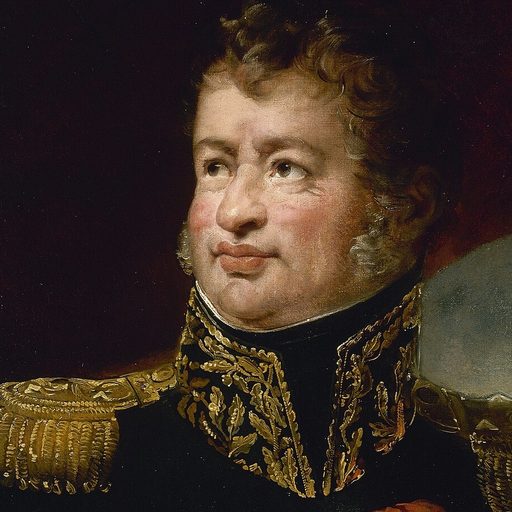
Joseph Léopold Sigisbert HUGO
See onthe map
Officer of the Revolution and the Empire, father of Victor Hugo.
General Léopold Hugo, Victor's father, fought in the Vendée war, the Rhine campaign, Italy and Spain, where Joseph Bonaparte made him Count of Sigüenza and governor of Ávila and then of Segovia. In 1815 he held Thionville for three months under the blockade of the coalition armies without surrendering the town. His son had the sentence carved on the obelisk in 1870: “Through him Thionville remained French” — the very year the town fell to the Prussians.
The story
Born in Nancy on 15 November 1773, Léopold Hugo enlisted at fifteen and served under the Revolution and then the Empire. He followed Joseph Bonaparte to Spain, where he governed Ávila and then Segovia and received the title of Count of Sigüenza.
His feat of arms was a siege. In 1815, after Waterloo, he held Thionville for three months under Allied blockade and never gave the town up. It is that town held that his son would have carved on his grave.
That son, Victor, would write the most famous line a poet ever addressed to his father: “Mon père, ce héros au sourire si doux” — my father, that hero with so gentle a smile — which opens “Après la bataille” in 1859, thirty-one years after the general's death. The line tidies up the memory: in 1818 the civil court of the Seine had granted Léopold Hugo and Sophie Trébuchet a legal separation, and the writer's childhood had been spent between two camps.
He died in Paris on 29 January 1828, at fifty-four. Victor was twenty-five: the battle of Hernani, the theatre riot that would make him the leader of the Romantics, came two years later.
In 1870, with Paris besieged by the Prussians, Victor Hugo, back from exile, had this carved on the obelisk: “Par lui Thionville resta française” — through him Thionville stayed French. Thionville capitulated on 24 November of that same year and became German in 1871. The stone, for its part, makes the general two years younger than he was: it gives his birth as 1775. Lying there, in Division 27, are Sophie Trébuchet, who died in 1821; Eugène, Victor's brother (1800-1837); his two sons, Charles (1826-1871) and François-Victor (1828-1873); and his grandson Georges Victor-Hugo (1868-1925). Victor Hugo himself is in the Panthéon.
The grave
A stone obelisk, in Division 27, Chemin Saint-Louis, first row, with four generations of the family beneath it. It lists the general's campaigns — “war in the Vendée, campaign of the Rhine, war in Italy, war in Spain, campaign of France, siege of Thionville, from 1792 to 1815” — and ends with the sentence Victor Hugo had carved there in 1870: “Through him Thionville remained French”. The stone gets both births wrong: it has the general born on 15 November 1775 instead of 1773, and his wife Sophie Trébuchet in 1780 instead of 1772.
On site, do not miss
Read the obelisk from top to bottom: it lists six campaigns, “from 1792 to 1815”, and ends with “Through him Thionville remained French”. Then check the two dates of birth: the stone gives 1775 for the general, born in 1773, and 1780 for his wife Sophie, born in 1772. It is wrong twice.
Visitors' questions
Where is the grave of Victor Hugo's father?
In Division 27, Chemin Saint-Louis, first row, beneath a stone obelisk. The balloonist Gaston Tissandier lies on the same path and the same row, under a slab carved with a balloon, in the high, old part of the cemetery.
Gaston TissandierDoes Victor Hugo rest at Père-Lachaise?
No: he lies in the Panthéon, since his state funeral in 1885. But the obelisk in Division 27 gathers his father, his mother Sophie Trébuchet, his brother Eugène, his two sons Charles and François-Victor, and his grandson Georges.
Honoré de BalzacWhat does “Par lui Thionville resta française” mean?
“Through him, Thionville remained French”: General Hugo held the town for three months under the blockade of the coalition armies, in 1815, without surrendering it. Victor Hugo had the words carved in 1870, during the siege of Paris — the inscription is as much a protest as a tribute. Thionville capitulated all the same on 24 November 1870, was annexed by the German Empire in 1871, and did not become French again until 1918.
General de NansoutyWas General Hugo really “ce héros au sourire si doux”?
The line — “that hero with the gentle smile” — is his son's, and it tidies up the memory: the civil court of the Seine had separated the general and Sophie Trébuchet in 1818, and Victor Hugo's childhood was spent between two camps. He wrote it in 1859, in “Après la bataille”, thirty-one years after his father's death. Gérard Berliner's show Mon alter Hugo played on that gap.
Gérard BerlinerAudio guide to Père Lachaise: the best unusual guided tour!
Discover the secrets of the most astonishing tombs
the audio guidefrom€6.99