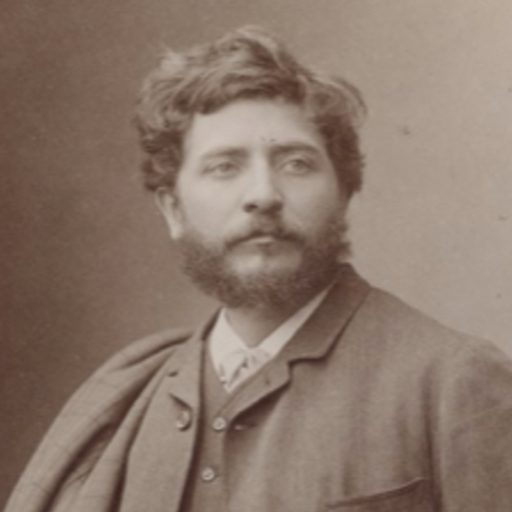
Carriès, an orphan from Lyon raised by nuns, taught himself in front of the busts of the Louvre, and his heads of infants and beggars stood out for their rawness against the marbles of the Salon. The Japanese art exhibition of 1888 overwhelmed him: he left sculpture for glazed stoneware, and spent years searching for how to obtain his glazes. A monumental doorway cost him five years of work.
The story
An orphan from Lyon raised by the Sisters of Saint Vincent de Paul, Jean-Joseph Carriès reached Paris in 1874 and taught himself, copying the busts of the Louvre. His first sculptures — heads of infants, masks of old men, figures of beggars — cut against the official marble of the Salon by their rawness.
In 1878 the Exposition Universelle at the Trocadéro put Japanese glazed stoneware in front of him, and overturned him. Ten years later he gave up Salon sculpture, settled at Saint-Amand-en-Puisaye in the Nièvre, and spent years breaking into the secret of the glazes: running enamels, coppers, yellows, matt blacks, ceramic flesh that seems to breathe.
In 1889 the princesse de Scey-Montbéliard — Winnaretta Singer, heiress to the American sewing machines and the future princesse de Polignac — ordered from him a monumental door meant to house the manuscript of Parsifal. Carriès put into it everything he owned and five years of work: hundreds of pieces of stoneware, masks, frogs, a whole architecture of fired clay.
He died in 1894 of pleurisy, the door unfinished, ruined. His stoneware is in the Petit Palais and the Musée d'Orsay today. He lies in Division 12, a few steps from Géricault.
On site, do not miss
The sobriety of the grave, striking for a man whose entire work lies in material and glaze. Nothing here recalls the stoneware.
Visitors' questions
Where is Jean Carriès's grave?
In Division 12 of Père-Lachaise, on the western flank of the cemetery. It is the Division of Théodore Géricault's monument, topped by the bronze of The Raft of the Medusa, the simplest landmark to steer by in this quarter.
Théodore GéricaultWhat is the Porte de Parsifal?
A monumental door in glazed stoneware commissioned from Jean Carriès in 1889 by the Princesse de Scey-Montbéliard, to house the manuscript of Parsifal. The sculptor gave it five years and ruined himself over it; it was still unfinished when he died in 1894.
Painters & sculptors at Père-LachaiseWhy did Jean Carriès give up sculpture?
Because of Japan. The Exposition Universelle of 1878 revealed Japanese stoneware to him; ten years later he left Paris for Saint-Amand-en-Puisaye and spent the rest of his life trying to recover the secret of the glazes.
Curiosities of Père-LachaiseWhere can you see Jean Carriès's work today?
At the Petit Palais and the Musée d'Orsay in Paris, and at the stoneware museum in Saint-Amand-en-Puisaye. His stoneware masks and figures, long forgotten, have been sought after again since the 1990s.
François-Joseph TalmaAudio guide to Père Lachaise: the best unusual guided tour!
Discover the secrets of the most astonishing tombs
the audio guidefrom€6.99