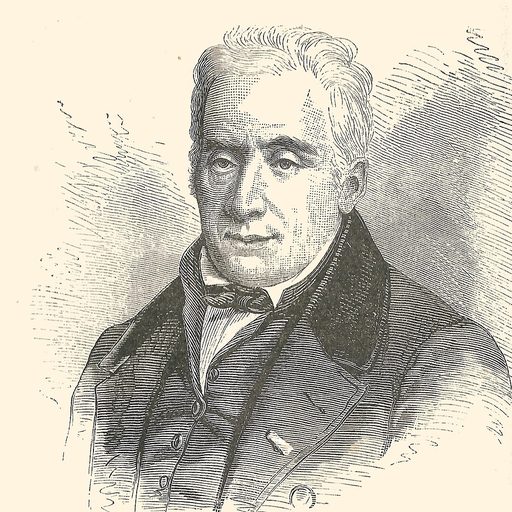
A farmer's son, he set off on foot from the Calvados for Rouen at seventeen: one hundred and thirty kilometres to the textile capital of the country. He would introduce cotton weaving into France, and owes his double name to a partnership. His stone keeps to the civil record; a Paris boulevard, for its part, bears his name.
The story
At seventeen, François Richard set out on foot for Rouen, the textile capital of the kingdom: a hundred and thirty kilometres from Épinay-sur-Odon, in the Calvados, where he had been born a farmer's son on 16 April 1765. The merchant who took him on did not teach him trade: he made him his servant.
He brought cotton weaving to France, the industry that would make the fortune of Normandy and Alsace in the century that followed: it was an English prisoner of war named Browne who set up his first looms, in a guinguette on the rue de Bellefonds. His partnership with the merchant Joseph Lenoir-Dufresne, met at an auction over a length of cloth, gave him the double name under which he would remain known.
He died in 1839. The stone in Division 42 runs to three elements: “François RICHARD-LENOIR 1765-1839.” Not the trade, not the cotton, not the partner. The name itself is written large elsewhere in Paris, on a boulevard and on a street.
The grave
An inscription of three elements: “François RICHARD-LENOIR 1765-1839.” Neither the profession, nor the cotton, nor the partner Lenoir from whom he took the second half of his name. It is elsewhere that this name is written large: on the boulevard and the rue Richard-Lenoir, in Paris — one of the rare industrialists in the cemetery whose name the city retained.
On site, do not miss
The name can be read in large letters elsewhere in Paris: a boulevard bears it, two kilometres from Division 42. The stone, for its part, keeps to the civil record.
Visitors' questions
Where is François Richard-Lenoir's grave?
In Division 42, chemin des Anglais, fourth row — the Division of Gérard Fromanger and Téo Hernandez. The inscription runs to three items: “François RICHARD-LENOIR 1765-1839”. He died in 1839.
Gérard FromangerWhat did he bring to France?
Cotton weaving — the industry that would make the fortune of Normandy and Alsace in the century that followed. He was a farmer's son and had left the Calvados on foot.
Émile OberkampfWhere does the double name come from?
From his partner, a man named Lenoir: his own name was François Richard, and it is the compound that stuck — the one carried today by the boulevard Richard-Lenoir, in Paris.
Alexis MuzetDid he really set off on foot?
At seventeen, he set out on foot for Rouen, then the textile capital of France. From Épinay-sur-Odon that is some hundred and thirty kilometres.
Sadegh SharafkandiAudio guide to Père Lachaise: the best unusual guided tour!
Discover the secrets of the most astonishing tombs
the audio guidefrom€6.99