The Greffulhe Chapel
See onthe map
First funerary chapel in the cemetery.
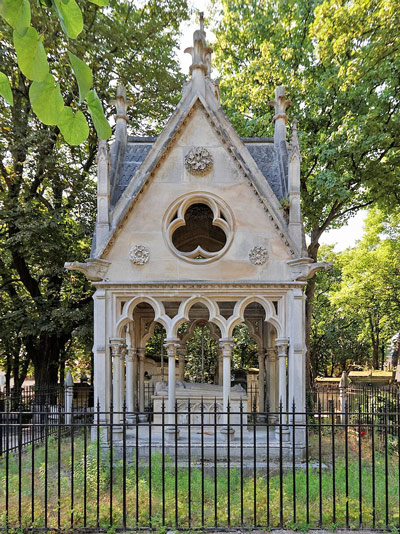
Greffulhe, a banker and peer of France, had his chapel built around 1810, when the cemetery was six years old and still struggling to fill. The plans were by Brongniart, who had designed the place and would complete no other chapel: he died in 1813. On thirty-six square metres, the building imitates an entire neo-Gothic church, pointed arches, pinnacles and stained glass. All Paris wanted one at once.
The story
When Count Greffulhe, banker and Peer of France, commissioned his chapel around 1810, the cemetery was six years old and struggling to fill: Parisians still mistrusted this English park laid out on a hill beyond the walls.
Alexandre-Théodore Brongniart, who designed Père-Lachaise itself, drew the plans. It would be the only chapel he saw finished: he died in 1813, and it is at Père-Lachaise that he lies himself.
On thirty-six square metres the building reproduces a complete neo-Gothic church — pointed arches, pinnacles, stained glass. The effect on fashionable Paris was immediate: the great families demanded their own, and the model spread.
From this chapel descend the hundreds of pocket churches lined up along the paths, which became the visual signature of the cemetery. The name would grow famous another way: the family produced Countess Élisabeth Greffulhe (1860-1952), a patron of music, founder of the Société des Grandes Auditions, backer of the first Paris season of the Ballets Russes in 1909 — and the acknowledged model for the Duchesse de Guermantes in Proust.
Division 43 keeps the original, framed today by buildings far later than itself. No account describes its interior or its inscriptions: the chapel is read from outside.
On site, do not miss
Compare it with the neighbouring chapels: it is smaller and finer than those it inspired. The original was more measured than its copies.
Visitors' questions
Where is the Greffulhe chapel?
In Division 43 of Père-Lachaise. You will know it by its shape — a miniature neo-Gothic church, thirty-six square metres of pointed arches and pinnacles — flanked by chapels built much later, which it inspired.
Alphonse LavalléeWhy are there so many chapels at Père-Lachaise?
Because the Greffulhe chapel set the fashion. The stir it caused around 1810 drove the great families to demand chapels of their own, and these pocket-sized churches became the cemetery's visual signature, right up to the monumental mausoleums of the Second Empire.
Élisabeth DemidoffWho was Brongniart?
Alexandre-Théodore Brongniart (1739-1813), the architect who laid out Père-Lachaise in 1804 on the model of the English landscape garden. The Greffulhe chapel is the only one he completed, and he himself lies buried in the cemetery he designed.
Alexandre-Théodore BrongniartWho was Countess Greffulhe?
Élisabeth Greffulhe (1860-1952), the most admired woman in Belle Époque Paris. A patron of music, she backed the Ballets Russes' first Paris season in 1909 and served Marcel Proust as the model for the Duchesse de Guermantes.
Marcel ProustAudio guide to Père Lachaise: the best unusual guided tour!
Discover the secrets of the most astonishing tombs
the audio guidefrom€6.99