Antoine PONSAT
See onthe map
Man of independent means.
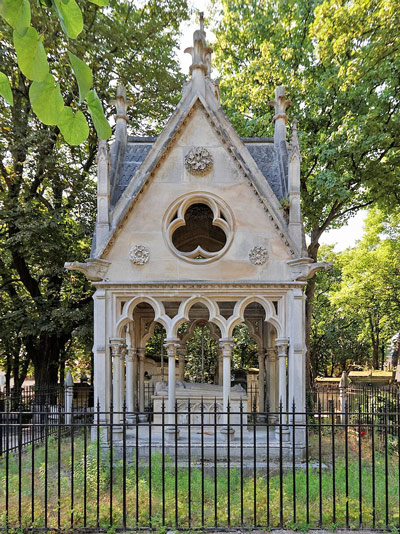
Born in a village of the Creuse, he lived on his private income and died in 1893 “in his mansion” on the boulevard de Courcelles: the rise fits in two lines of a civil record. His stone bears three epitaphs of bourgeois mourning — “Il laisse de profonds regrets”, he leaves deep regrets — each followed by the De profundis.
The story
Born in 1811 at Vallière, in the Creuse, Antoine Ponsat was the son of Sylvain Ponsat and Marie Tournier. He married Marie Palmyre Landon. His profession, the only one the registers keep, is that of rentier: he did not work, he lived on his income. In the nineteenth century the word denotes a social position more than a trade, and it says a great deal — the Creuse was then a department of emigration which supplied Paris with masons, and most of those who left came back masons or stonecutters. He had made fortune enough to follow no trade at all.
He died on 6 January 1893 “in his own hôtel”, on the boulevard de Courcelles, in the 17th arrondissement — a new avenue traced along the parc Monceau under the Second Empire, for the fortunes on their way up. A man born in a Creuse village and dead in his own town house at that address: the ascent fits into two lines of a civil register.
What is left of him is on the stone. Two epitaphs answer each other there, in the language of bourgeois mourning of the time. For him: “Il laisse de profonds regrets. De profundis.” — he leaves deep regrets. For his mother-in-law, dead on 16 November 1849: “Elle fut la meilleure, et la plus tendre des mères. De profundis.” — she was the best and the most tender of mothers. A third line carries only a name, without a word: “Madame Veuve Antoine PONSAT, née Marie Palmyre LANDON”. The Latin formula — Out of the depths I cry unto thee, the opening verse of Psalm 129 — comes twice, like a family signature.
These phrases are formulas, and they were formulas already when they were cut. That is precisely what makes them interesting: they show what a well-off family of the Second Empire thought it proper to write on its dead. The same lines, within a few words, are found on hundreds of Parisian graves of the period. Under this slab in Division 31 lie a mother, her daughter and that daughter's husband: the kind of grave that tells not a life but a way of dying in society.
The grave
A family stone that preserves three epitaphs of the century's bourgeois mourning. For him: “Antoine PONSAT, décédé en son hôtel, à Paris, le 6 janvier 1893. Il laisse de profonds regrets. De profundis.” — Antoine Ponsat, died in his mansion in Paris on 6 January 1893. He leaves deep regrets. De profundis. For his mother-in-law: “Mme Vve LANDON, née Anne Juliette JOLIET, décédée à Paris, le 16 novembre 1849. Elle fut la meilleure, et la plus tendre des mères. De profundis.” — Madame Landon, widow, née Anne Juliette Joliet, died in Paris on 16 November 1849. She was the best and the most tender of mothers. De profundis. Then comes “Madame Veuve Antoine PONSAT, née Marie Palmyre LANDON”. The De profundis — the first verse of Psalm 129 — returns twice, like a family signature.
On site, do not miss
Three epitaphs answer one another on the same stone, each followed by the De profundis. They say less about these dead than about what a family of the Second Empire thought proper to write.
Visitors' questions
Where is Antoine Ponsat's grave?
In Division 31 of Père-Lachaise, the one where the Duke of Bassano and the Duke of Massa lie. The inscription reads “Famille PONSAT” and carries three epitaphs — for him, for his mother-in-law and for his wife. They can still be read perfectly.
The Duke of Massa, Division 31What is known about his life?
Very little: born in 1811 at Vallière, in the Creuse, son of Sylvain Ponsat and Marie Tournier, husband of Marie Palmyre Landon, a man of independent means — that is, he lived on his income and followed no trade.
Antoine Louis de BoissièreWhat was a rentier?
Someone who lived on his income without practising a trade. In the nineteenth century the word describes a social position rather than a profession — and it says all the more in a man born in a village of the Creuse, a department people left.
Jacques LebelWhat do the epitaphs say?
For him: “Il laisse de profonds regrets. De profundis.”, he leaves deep regrets behind him. For his mother-in-law: “Elle fut la meilleure, et la plus tendre des mères.”, she was the best and the most tender of mothers. Set phrases, conventional already in their own day — and that is exactly what makes them evidence.
Jean-Joseph RacineAudio guide to Père Lachaise: the best unusual guided tour!
Discover the secrets of the most astonishing tombs
the audio guidefrom€6.99