From 1941 to 1944, the Gestapo forced anonymity on resistance fighters cremated at the Père-Lachaise columbarium. The occupying forces desecrated graves and erased antifascist inscriptions, even as the cemetery received the remains of those who had fought.
In the columbarium at Père-Lachaise, a handful of niches bear a small French flag in the corner and the word “Unknown.” No name, no date, no epitaph. These are the urns of Resistance fighters cremated between 1941 and 1944 on Gestapo orders, which imposed anonymity after cremation for the “terrorists” who died under torture or during transfer. Jean Moulin was cremated at Père-Lachaise. His ashes, placed in a niche bearing only the inscription “Inconnu, incinéré le 09-07-43” (“Unknown, cremated on 9 July 1943”), would remain there for twenty-one years, until their transfer to the Panthéon on 19 December 1964. Pierre Brossolette, another leading figure of the domestic Resistance, met the same fate. These anonymous niches, still there to be seen, are among the starkest reminders of what the Occupation did to the cemetery.
The occupiers did not stop at erasing the dead. As early as 1941, the German authorities' search for raw materials led them to strip bronze and cast-iron monuments. The chains encircling Victor Noir's grave were torn away to be melted down into cannon. In Division 97, the grave of Gerda Taro, the first woman war photographer, killed in 1937 on the Brunete front in Spain, bears a different scar: the inscription recording her role in the Spanish Civil War was erased on the occupiers' orders. The monument, designed by Alberto Giacometti, was stripped of the very thing that gave it political weight. By contrast, the grave of Édouard Drumont, the antisemitic pamphleteer, received in 1943 an inscription celebrating his “immortal” work, La France juive. It would take until the year 2000 for a municipal order from the Conseil de Paris to have this addition removed. In four years of Occupation, the cemetery underwent a rewriting: what resisted was erased, what collaborated was honoured.
Jean Moulin was cremated at Père-Lachaise. His ashes, placed in a niche bearing only the inscription “Unknown, cremated 9 July 1943,” would remain there for twenty-one years.
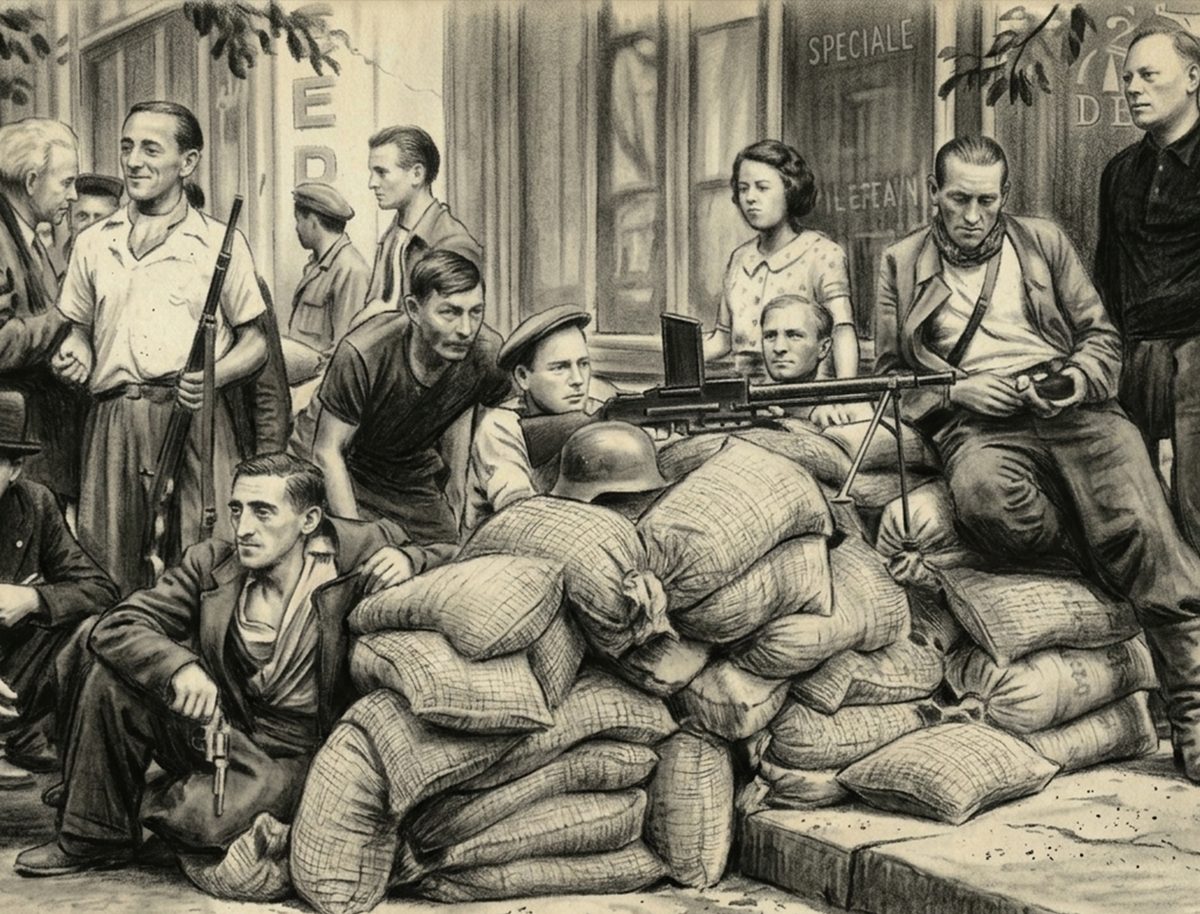
Stories have long circulated of arms caches hidden in vaults, fallback points for the Milice, or refuges for collaborators on the run. The Association des amis et passionnés du Père-Lachaise (the Friends of the cemetery) files these under the legends that the official record has swept away. What is documented is plainer, and more damning. Pierre Sémard, general secretary of the CGT railway workers' federation, handed over by Vichy to the Nazis, was shot on 7 March 1942; he rests in Division 97. Colonel Fabien — Pierre Georges by birth, the man who shot dead a Kriegsmarine cadet officer on 21 August 1941 at the Barbès-Rochechouart Métro station — was buried in the same Division after his death in combat in Alsace on 27 December 1944. On 8 October 1944, a few weeks after the Liberation, a ceremony was held at the cemetery in honour of intellectuals who had died for France, attended by Aragon, Éluard and Picasso. The cemetery, which had served as a stage for erasure, was beginning to become one of recognition.
Père-Lachaise still carries discreet but stubborn traces of this period. The anonymous niches are still there to be seen in the columbarium. In Division 97, facing the Communards' Wall, the graves of Sémard and Colonel Fabien stand beside the cenotaph raised in 1989 to the FTP-MOI fighters of the Manouchian group — a mosaic monument designed by the architect Jean-Michel Daquin and the mosaic artist Verdiano Marzi, whose commander was inducted into the Panthéon on 21 February 2024. Further on, along the Avenue Circulaire, some fifteen monuments erected between 1946 and 2017 commemorate the concentration and extermination camps — Auschwitz, Ravensbrück, Mauthausen, Buchenwald — forming a memorial ensemble with no equal in France. The Occupation left no explanatory plaques here, no marked trail. But the visitor walking along the Avenue Circulaire passes, often without knowing it, the memory of a period when the cemetery was at once an instrument of erasure and a place of resistance.
Which Second World War resistance fighters are buried at Père-Lachaise?
Pierre Sémard, secretary of the railway workers' union CGT, shot on 7 March 1942, and Colonel Fabien, killed in combat on 27 December 1944, lie in Division 97 of Père-Lachaise. A cenotaph honouring the FTP-MOI fighters of the Manouchian group was unveiled there in 1989.
What are the anonymous cinerary niches at the Père-Lachaise columbarium?
They hold the urns of resistance fighters cremated between 1941 and 1944 on Gestapo orders, which required anonymity for “terrorists” who died under torture. They bear a small French flag and the word “unknown.” Jean Moulin's ashes rested there from 1943 to 1964.
Were graves desecrated at Père-Lachaise during the Occupation?
From 1941, the Nazis stripped bronze and cast-iron elements to melt down for cannons — including the chains on Victor Noir's grave. The inscription on Gerda Taro's grave in Division 97 was erased. In 1943, the grave of antisemitic pamphleteer Édouard Drumont received an addition celebrating his work.
Are there Second World War monuments at Père-Lachaise?
Yes. Around 15 monuments commemorating the Nazi camps — Auschwitz, Ravensbrück, Mauthausen, Buchenwald — were erected between 1946 and 2017 along the Avenue Circulaire of Père-Lachaise, between Divisions 76 and 97, forming a memorial ensemble unique in France.
 History