Père-Lachaise holds fifty-six Russian graves. The first dates from 1814, when the tsar's troops camped in the cemetery. The Demidoff-Stroganov mausoleum, the most imposing at Père-Lachaise, overlooks the Charonne cliff.
In 1814, Russian troops advancing on Paris with the allied armies against Napoleon fought fierce battles at Père-Lachaise. Students from the École polytechnique and the veterinary school of Maisons-Alfort defended Charonne hill — the cemetery's most romantic sector. The Russians won and set up camp among the graves. The cold was so bitter that they cut down every poplar on the avenue des peupliers to keep warm. The avenue was replanted with horse chestnuts and became Transverse Avenue No. 1. A Russian officer killed in the fighting was buried in the cemetery — the first Orthodox believer buried at Père-Lachaise, which until then had held only Catholics, Protestants, Jews and atheists.
In April 1818, Count Demidoff had his wife, Baroness Elisabeth Strogonoff, buried in a magnificent mausoleum at the top of the cemetery — a small temple in the antique style, with a sarcophagus of Carrara marble, designed by the architect Jaunet. Around 1840, the count's son, Prince Demidoff — husband of Princess Mathilde, a cousin of Napoleon III — had the tomb moved and set on an enormous stone foundation designed by the architect Danjoy. The foundation shores up the Charonne cliff along the chemin du Dragon. Gold-beater's hammers, sables and wolves' heads are carved into the stone. The Demidoff mausoleum is the most imposing monument at Père-Lachaise.
In 1814, the victorious Russian soldiers camped in the cemetery. The cold was so severe that they cut down every poplar along the avenue for firewood. The Avenue des Peupliers became the Allée des Marronniers, then Transverse Avenue No. 1.
Other spectacular Russian tombs punctuate the cemetery. The open chapel of Princess Zénaïde Dolgorouky in Division 48, topped with an Orthodox bell tower, houses a life-size marble group by Daniel Campagne. In Division 49, the marble recumbent effigy of the dancer Hélène Andrianoff, carved by Antonio Rossetti in 1857, is one of the finest in the cemetery. In Division 82, the funerary basilica of Jean de Yakovleff, painted by Fedoroff, carries the visitor into a Russian church. After 1917, the cemetery received exiles from the Bolshevik revolution: Alexandre Potressoff, founder of Russian social democracy, who died in Paris in 1934 and lies in Division 87, and Boris Bajanov, Stalin's secretary, who died in Paris in 1982 and lies in Division 49.
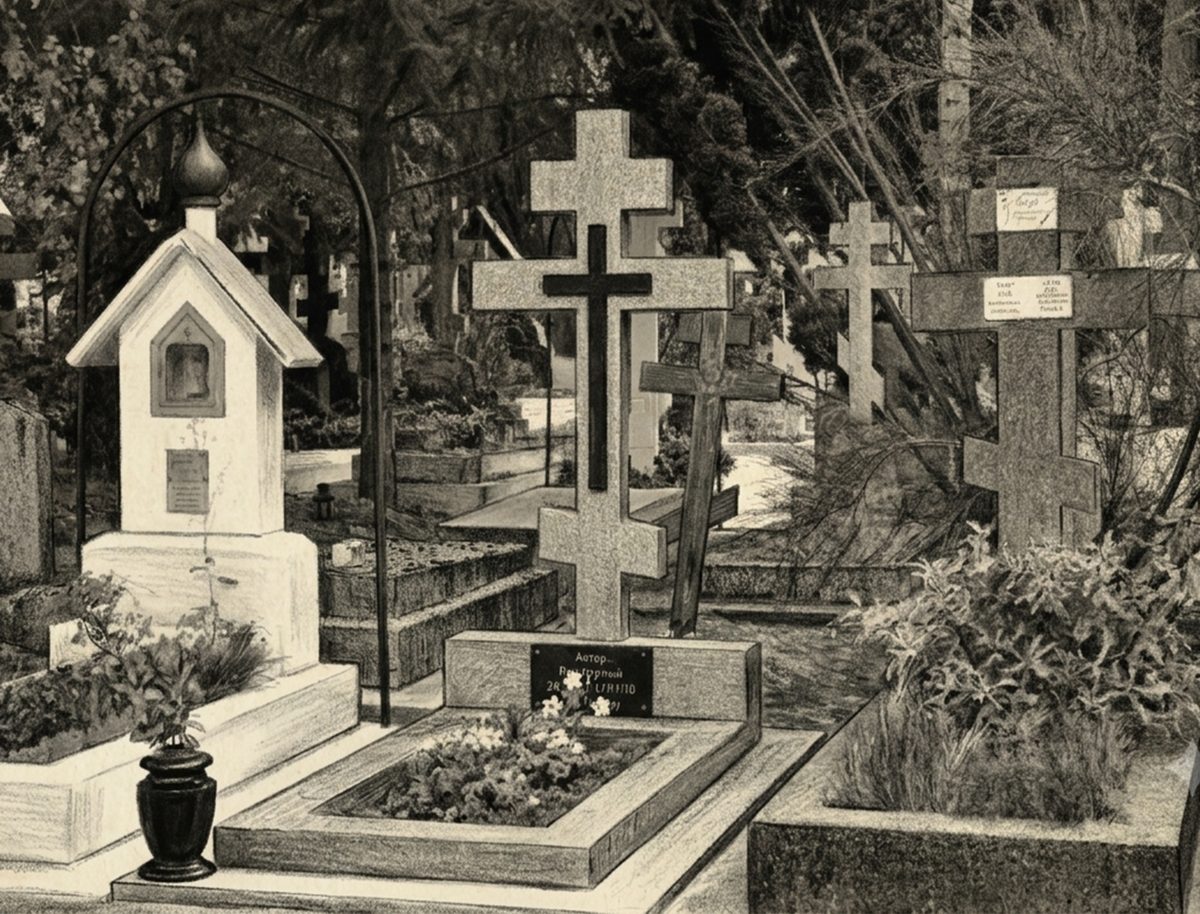
A visitor walking the chemin du Dragon at Père-Lachaise passes along the Charonne cliff and looks up at the Demidoff mausoleum — a monument so massive it seems to belong to a different scale from the rest of the cemetery. In Division 84, the Memorial to Russian Fighters of the French Resistance, unveiled on 3 May 2005 for the sixtieth anniversary of the victory over Nazism, shows a bronze Resistance fighter in action, made in Moscow by the sculptor Vladimir Sourovtsev. Père-Lachaise holds 56 Russian graves. Orthodox crosses are scattered across the Divisions, recognisable by their slanted crossbar. Russia and Père-Lachaise have shared a history since 1814 — from the Tsar's soldiers to the revolution's exiles, from princes to Resistance fighters.
Yes. Père-Lachaise holds 56 Russian graves, from the Demidoff-Strogonoff mausoleum — the largest in the cemetery — to the graves of exiles from the 1917 revolution. Orthodox crosses are recognisable by their slanted lower bar.
The Demidoff-Strogonoff mausoleum is the largest monument at Père-Lachaise. Built for Baroness Elisabeth Strogonoff in 1818, the tomb overlooks the Charonne cliff from a stone base designed by architect Danjoy around 1840.
In 1814, Russian troops allied against Napoleon fought fierce battles at Père-Lachaise against students of the École polytechnique. After their victory, the Russian soldiers camped in the cemetery and cut down poplar trees for firewood.
Are Russian resistance fighters buried at Père-Lachaise?
Yes. The memorial to Russian fighters killed in the French Resistance stands in Division 84 of Père-Lachaise, unveiled on 3 May 2005. The bronze sculpture, made in Moscow by Vladimir Sourovtsev, depicts a resistance fighter in action.
 History