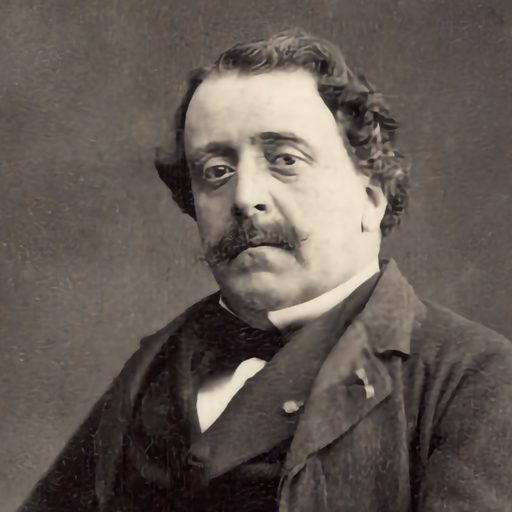
Paul de Saint-Victor was among the most feared critics of his time: with one article, the same evening, he could bring down a play. He held the column at La Presse, then at the regime's newspaper. His great book, devoted to the masks of the ancient theatre and our own, appeared at the end of his life, after thirty years spent judging others. Four words, on his stone, stand in for all the rest.
The story
His articles made and unmade reputations. A literary and dramatic critic, Paul de Saint-Victor was one of the most powerful of the Second Empire: what he wrote of a play in the evening often decided its fate.
Born in Paris on 11 July 1827, his name was Paul Jacques Raymond Bins, comte de Saint-Victor, son of the comte Jacques de Saint-Victor. He wrote in La Presse, then in the Moniteur universel, the official journal of the regime.
His great book appeared at the end of his life: Les Deux Masques, an essay on Greek and modern theatre, published in 1880-1881 by a man who had spent thirty years judging other people's plays. He died in 1881.
On the stone in Division 9, four words: “Paul de SAINT VICTOR.” No dates, no title of nobility, no trade. The stone fell silent; it is the bust, signed Eugène Guillaume and dated 1882, that speaks.
The grave
A bust signed Guillot, and an inscription reduced to its simplest expression: “Paul de SAINT VICTOR.” Four words, without dates, without title of nobility — he was a count — without profession. For the most widely read critic of the Second Empire, whose articles made and unmade theatrical reputations, the stone chose silence and let the bust speak.
On site, do not miss
A bust signed Guillot, and an inscription reduced to four words: “Paul de SAINT VICTOR.” No dates, no title, no profession.
Visitors' questions
Where is Paul de Saint-Victor's grave?
In Division 9, avenue Latérale Sud, first row, beneath a bust signed Guillaume. The inscription comes down to four words: “Paul de SAINT VICTOR” — no dates, no profession, no title. He died in 1881, at fifty-three.
Paul DuboisWhat is Les Deux Masques?
His great book, published in 1880-1881: an essay on Greek and modern drama, written at the end of his life by a man who had spent thirty years judging other people's plays.
Jules ClarétieWhere did he write?
In La Presse, then at the Moniteur universel — the regime's official gazette. He was one of the most powerful critics of the Second Empire: his columns made and unmade reputations.
Jules CornélyWas he a nobleman?
He was: Paul Jacques Raymond Bins, Comte de Saint-Victor, son of Comte Jacques de Saint-Victor. His epitaph gives neither the title nor the full names — four words and no more.
Albert FouriéAudio guide to Père Lachaise: the best unusual guided tour!
Discover the secrets of the most astonishing tombs
the audio guidefrom€6.99