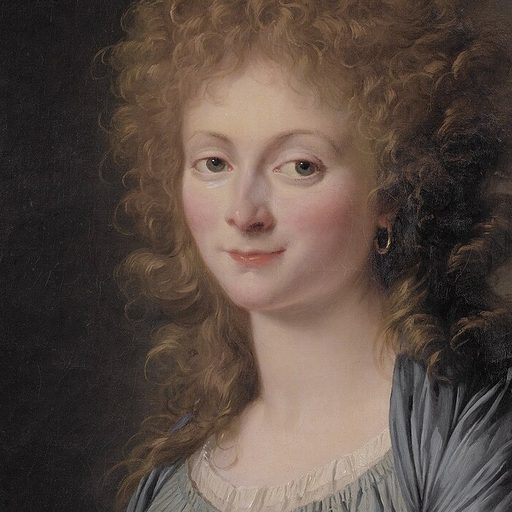
Born in Pau in 1770, Jeanne de Navailles belonged to the aristocracy of the Ancien Régime and married the son of that Marquis de Girardin who sheltered Rousseau at Ermenonville. Adélaïde Labille-Guiard, one of the very few women the Royal Academy ever admitted, painted her portrait. An anonymous marble bust portrays her, within a railing whose corners are each adorned with a flame. No date is carved.
The story
A railing with a flame at each corner surrounds the marble bust of Jeanne Henriette Victoire de Navailles: the arrangement is rare at Père-Lachaise, and the bust, finely made, is unsigned.
Born at Pau on 5 May 1770, she was married at fourteen, in January 1785, to the last duc d'Aiguillon, and became a duchess. Imprisoned at the Carmes under the Terror and widowed in 1800, she married the following year Alexandre François Louis, comte de Girardin, son of the marquis who welcomed and sheltered Jean-Jacques Rousseau at Ermenonville, where the philosopher spent his last months in 1778.
Adélaïde Labille-Guiard, one of the very few women received into the Académie Royale de Peinture, painted her portrait in 1790. Lady-in-waiting to Julie Clary, the wife of Joseph Bonaparte, from 1805 to 1813, she died in Paris on 7 June 1818, at forty-eight.
The inscription carries no date, and not a word of the title of duchess: “A la mémoire, de Jeanne Henriette Victoire, de NAVAILLES, comtesse Louis de GIRARDIN.” Then comes a quatrain: “Si les vertus, les grâces, l'esprit et la beauté étaient des titres à l'immortalité, elle serait encore sur la terre l'image de la divinité” — if virtue, grace, wit and beauty were titles to immortality, she would still be on earth, the image of the divine.
The grave
A marble bust of fine workmanship, anonymous, surrounded by a railing whose every corner is adorned with a flame. The inscription is surprisingly brief and bears no date: “A la mémoire, de Jeanne Henriette Victoire, de NAVAILLES, comtesse Louis de GIRARDIN.” — To the memory of Jeanne Henriette Victoire de Navailles, Countess Louis de Girardin. Nothing of Pau where she was born, nothing of her portrait by Adélaïde Labille-Guiard, nothing of her husband's family — that of the Marquis de Girardin, who sheltered Rousseau at Ermenonville.
On site, do not miss
An anonymous marble bust, surrounded by a railing whose every corner is adorned with a flame. The inscription gives no date.
Visitors' questions
Where is Jeanne de Navailles's grave?
In Division 8, chemin du Coq, second row. You know it by its marble bust, finely made but unsigned, ringed by a railing with a flame at every corner — an arrangement rare in the cemetery.
Pierre-Jean de BérangerWho painted her portrait?
Adélaïde Labille-Guiard, official painter to the Court and one of the few women admitted to the Royal Academy — and the wife, as it happens, of the painter François-André Vincent, buried in Division 11 of the same cemetery, whose stone carries an error of thirty years.
François-André VincentWho was her husband?
Count Louis Stanislas de Girardin, son of the Marquis de Girardin — the man who took in and sheltered Jean-Jacques Rousseau at Ermenonville, where the philosopher spent his last months, in 1778, and died.
Bernardin de Saint-PierreWhat does her inscription say?
Little enough: “A la mémoire, de Jeanne Henriette Victoire, de NAVAILLES, comtesse Louis de GIRARDIN.” — to the memory of. No dates, no place of birth — only her maiden name and her title as a wife, without a single date.
Louis Blanc, Division 67Audio guide to Père Lachaise: the best unusual guided tour!
Discover the secrets of the most astonishing tombs
the audio guidefrom€6.99