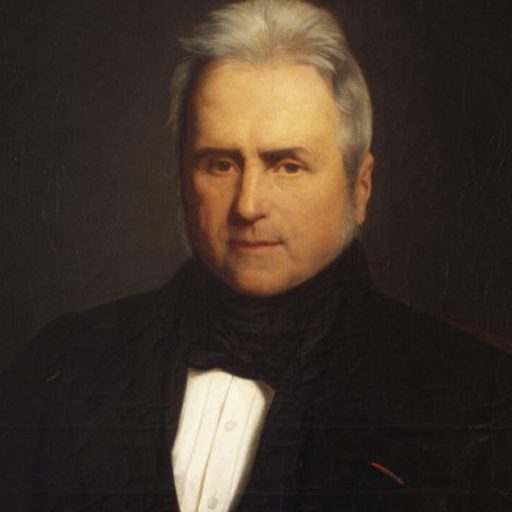
A carpenter's son who started as a bank clerk at sixteen, he was Governor of the Banque de France in 1814, advanced Napoleon the funds for his exile, then financed the revolution of July 1830 and pushed the Duke of Orléans onto the throne. President of the Council for four months, he came out of it ruined.
The story
Born at Bayonne in 1767, the son of a carpenter, Jacques Laffitte entered the Perregaux bank in Paris at sixteen as a clerk. He became its partner in 1807, its sole head in 1810, and was appointed in 1814 governor of the Banque de France, a post he held for six years. Perregaux ranked among the first houses on the Paris market: a carpenter's son had taken it over.
His fortune served contradictory causes. In 1815, after Waterloo, he advanced Napoleon the funds for his departure into exile and took part of his personal fortune into safekeeping — a gesture that would bring him trouble, and a reputation as a man of his word. Fifteen years later he was on the other side: a liberal deputy, he turned his townhouse into the headquarters of the opposition to Charles X. Few bankers of the century served in turn the fallen Empire and the opposition that would overthrow the Restoration.
In July 1830 the Trois Glorieuses, the three days of revolution, brought down the king. Laffitte was at the centre of the manoeuvre: it was he who financed the insurrection, he who rallied the hesitant deputies, he who pushed the Duke of Orléans onto the throne. He became president of the Council in November 1830 and held the office barely four months: Louis-Philippe, once installed, did without him. One king had been replaced by another, with the agreement of the banks.
The business cost him everything. His advances, his guarantees and the neglect of his own affairs during the crisis left him ruined; he had to sell his townhouse and his property, and a public subscription organised in 1831 saved him from bankruptcy. In 1836 he founded the Caisse générale du commerce et de l'industrie, one of the first French deposit banks, which foreshadowed the great houses of the Second Empire. He died in 1844 and lies in Division 30, avenue des Acacias. Of the revolution he had paid for, he came in the end to say: “Je demande pardon à Dieu et aux hommes d'avoir concouru à la révolution de Juillet” — I ask pardon of God and of men for having helped bring about the July revolution.
On site, do not miss
The fourth head of the Banque de France in the cemetery, with Garat in Division 7, Gaudin in 27 and Davillier in 40: French money has its own quarter here.
Visitors' questions
Where is Jacques Laffitte's grave?
In Division 30 of Père-Lachaise, that of Sébastien Bottin, whose directory gave its name to the Bottin. Jacques Laffitte was governor of the Banque de France, then Prime Minister.
Louis-Auguste BlanquiDid he bankroll the revolution of 1830?
He did, and he was one of its organisers: he put up the money, brought the wavering deputies round and pushed the Duke of Orléans onto the throne. He became President of the Council in November 1830 — for four months only.
Martin GaratWhat was his connection with Napoleon?
In 1815, after Waterloo, Laffitte advanced him the money for his departure into exile and took part of his personal fortune into safekeeping. The gesture brought him trouble, and a lasting name as a man whose word was good.
The Duke of GaetaWas he really ruined?
He was: his advances, his guarantees and the neglect of his own business during the crisis of 1830 left him ruined. He had to sell his town house, and a public subscription got up in 1831 saved him from bankruptcy.
Baron DavillierAudio guide to Père Lachaise: the best unusual guided tour!
Discover the secrets of the most astonishing tombs
the audio guidefrom€6.99