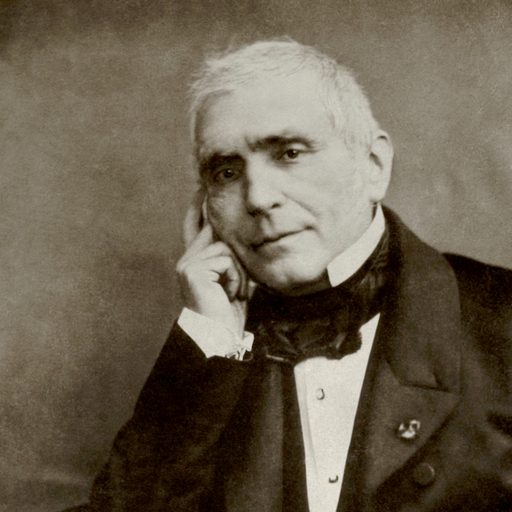
More than four hundred plays written in a workshop organised like a business, and the librettos of Auber, Meyerbeer, Donizetti and Verdi. His recipe for the “well-made play” set the pattern in Europe; Ibsen and Shaw fought it. His inscription bears his name and two dates, nothing else.
The story
Augustin Eugène Scribe was born in Paris on 24 December 1791. He ruled the French stage for forty years with an output whose sheer figure is enough to make the head swim: more than four hundred plays, often written in collaboration, in a workshop run like a business.
His method was the well-made play: a brisk exposition, a secret, a misunderstanding, a mechanical resolution. The formula was copied across Europe, and Ibsen and Shaw both fought it while knowing it by heart.
Above all he was the librettist of the century's great operas. Auber, Meyerbeer, Donizetti, Halévy and Verdi — “The Sicilian Vespers” — worked on his texts: few men of letters have mattered as much to music.
Elected to the Académie française in 1834, he became one of the wealthiest authors of his time. His theatre, built entirely on efficiency, is also the theatre that has aged worst.
He died in Paris on 20 February 1861. On the stone in Division 35, the inscription runs to his name and two dates: nothing of the four hundred plays.
The grave
A monument adorned with a bas-relief signed Lebègue and a medallion by Adam-Salomon — the photographer and sculptor who portrayed a good part of literary Paris. The inscription, for its part, is of a brevity that contrasts with the work: “Eugène Scribe, 1791 1861”. Not one play title, not one composer's name, no mention of the Académie française. Four hundred plays and the librettos of Verdi and Meyerbeer fit in two dates.
On site, do not miss
An inscription of two dates for four hundred plays: “Eugène Scribe, 1791 1861”.
Visitors' questions
Where is Eugène Scribe's grave?
In Division 35, avenue des Acacias, first row, in the upper part of the cemetery — the same path as the grave of Count Belliard. A bas-relief by Lebègue and a medallion by Adam-Salomon adorn the monument.
Augustin-Daniel BelliardHow many plays did he write?
More than four hundred, often in collaboration, in a workshop run like a business. He was the most prolific French playwright of the nineteenth century, and one of the wealthiest authors of his day.
Edmond AboutWhat is the “well-made play”?
His formula: a brisk exposition, a secret, a case of mistaken identity, a mechanical resolution. The method was copied all over Europe, and Ibsen and Shaw alike fought against it while knowing it by heart.
Georges CourtelineWhich composers did he write for?
Auber, Meyerbeer, Donizetti, Halévy and Verdi, for whom he wrote “Les Vêpres siciliennes”. Few men of letters mattered as much to nineteenth-century European opera as this purveyor of libretti.
François BazinAudio guide to Père Lachaise: the best unusual guided tour!
Discover the secrets of the most astonishing tombs
the audio guidefrom€6.99