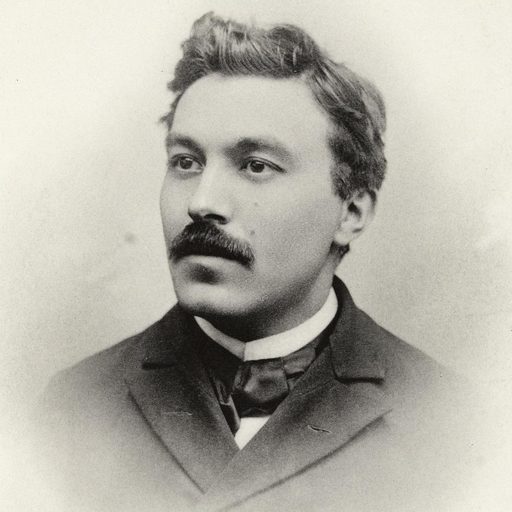
Arthur Rozier, born in 1870 in Romilly-sur-Seine, took over the CGT federation of white-collar workers at twenty-seven and held it for twelve years — he was still its general secretary when the voters of Paris sent him to the Chamber, in 1906. It was the path his generation was inventing, from the workshop to the Chamber. His stone keeps only the mandate and says nothing of the union. A street in the nineteenth arrondissement now bears his name.
The story
He carried trade unionism all the way to the ballot box. Born at Romilly-sur-Seine in 1870, Arthur Rozier became the fourth general secretary of the CGT Employees' Federation and ran it for twelve years, from 1897 to 1909.
Elected a socialist deputy for a Paris constituency in 1906, he was re-elected without a break until his death, and was among the founders of the Parti socialiste français — Jaurès's party.
He died in 1924. His stone in Division 91 keeps only one of his titles — “Arthur ROZIER, député de Paris, 1870-1924”, member of parliament for Paris — and says nothing of the twelve union years that took him there. A street in the 19th arrondissement of Paris carries his name today.
The grave
On the avenue Carette, second row, the inscription stops at the seat he held: “Arthur ROZIER, deputy for Paris, 1870-1924”. Neither the CGT, the main French trade-union confederation, nor the Employees' Federation he led for twelve years, nor socialism was cut into the stone, and no more were the eighteen unbroken years he spent in the Chamber, from 1906 until his death. His name reads larger elsewhere, on a street in the 19th arrondissement, the district for which he sat as a councillor.
On site, do not miss
The inscription fits on a single line and keeps the mandate rather than the union: “Arthur ROZIER, deputy for Paris, 1870-1924”. His name can be read elsewhere, in larger letters, on a street in the 19th arrondissement.
Visitors' questions
Where is Arthur Rozier's grave at Père-Lachaise?
In Division 91, Avenue Carette, second row. The stone carries a very brief inscription, reduced to his parliamentary office. Division 91 is also home to the revolutionary Louis-Auguste Blanqui.
Louis-Auguste BLANQUIWhat did Arthur Rozier do before becoming a deputy?
He ran a trade union. A workers' activist in Troyes and then Blois, and a Blois town councillor from 1896, he became the fourth General Secretary of the National Federation of Clerical Workers the following year, a post he held until 1909.
Casimir PERIERWhat does Arthur Rozier's gravestone say?
“Arthur ROZIER, deputy for Paris, 1870-1924.” Nothing else. Neither the Federation of Clerical Workers, nor the CGT, nor socialism appears on the stone — only the title his years in the union movement had led him to.
Augustin-Daniel BELLIARDWhere else does Arthur Rozier's name appear in Paris?
On a street in the 19th arrondissement, the district where he served as a town councillor from 1900. Today it is the most visible trace of his name — more so than his epitaph at Père-Lachaise.
Maurice DEKOBRAAudio guide to Père Lachaise: the best unusual guided tour!
Discover the secrets of the most astonishing tombs
the audio guidefrom€6.99